

No products in the cart.
THC Vape Online Australia
Delta 8 vs Delta 9 for Beginners: Potency Guide Australia
26
Jun
Jun
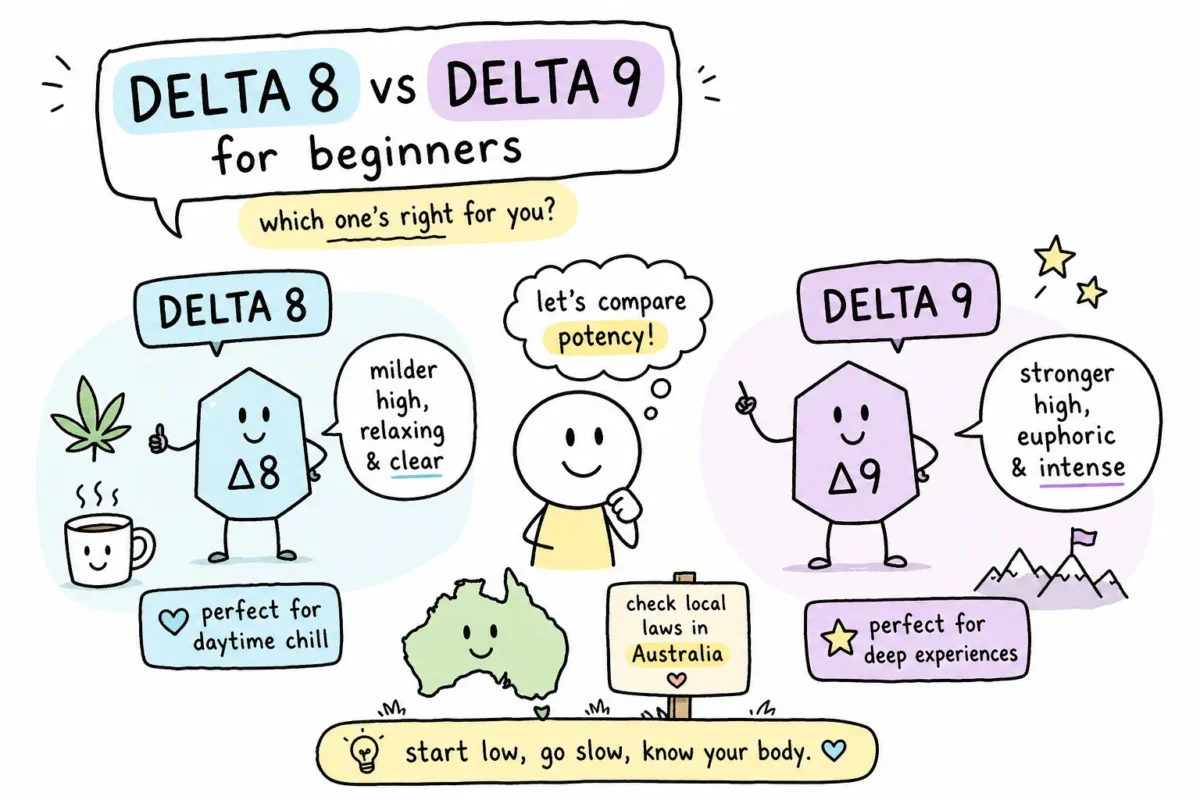
Which is stronger, delta 8 or delta 9 for beginners in Australia? It’s the first question most new users ask, and the answer matters more than you’d think. Most beginners hear that delta 8 is milder than delta 9 and assume it’s basically the same thing, just dialled back a notch. That’s partly true, but it misses a lot of what matters when you’re choosing between them for the first time. The two cannabinoids differ in more than just intensity: the way they bind to your brain, the side effects they carry, and how they behave across different product forms all vary in ways that genuinely change your experience.
Australians searching for both options can increasingly find retailers like THC Vape Online Australia stocking clearly labelled delta 8 and delta 9 products across vapes, gummies, and edibles. That makes the question more practical and less abstract. By the end of this article, you’ll know which cannabinoid suits a first-time user better, what dose to begin with, and what to look for before you buy.
The real potency gap between delta 8 and delta 9 for beginners
Delta 8 THC is roughly 50 to 67 percent as potent as delta 9 THC. This holds across both human clinical trials and animal studies, and it applies regardless of whether you’re vaping or eating an edible. The effect is meaningfully weaker, not just slightly softer around the edges. For a concise scientific review of cannabinoid potency and effects, see the published review on cannabinoid potency and effects.
The double bond that changes receptor binding
The structural difference comes down to one bond. Delta 9 has a double bond at the ninth carbon in its chain; delta 8 has it at the eighth. That small shift changes how well the molecule binds to the brain’s CB1 receptors. Delta 8 binds with lower affinity, which is why the psychoactive effect is softer. One bond position, two noticeably different experiences.
How much weaker is delta 8, really?
In practical terms: if 10 mg of delta 9 produces a noticeable high for a first-timer, you’d need roughly 15 to 20 mg of delta 8 to reach a comparable effect. There are no precise dose-equivalent studies yet, so treat that as a general guide rather than a formula. The more useful takeaway is that delta 8’s lower potency gives you a wider margin for error, which matters a lot when you’re still figuring out how your body responds.
What each cannabinoid actually feels like for beginners in Australia
Chemistry tells you why the potency differs. Whether that difference matters in practice depends on what kind of experience you’re actually after, and for a beginner, it matters quite a bit.
Delta 9’s stronger, more intense experience
Delta 9 hits harder and faster, particularly when vaped. The euphoria is more pronounced, the sensory shifts are more noticeable, and the duration tends to run longer. Those qualities are exactly why experienced users prefer it. For a first-timer, though, delta 9 carries a meaningfully higher risk of anxiety, paranoia, and racing thoughts, especially above 5 mg. The same strength that delivers the experience can push an unprepared beginner well past comfortable.
Delta 8’s calmer, more manageable ride
Delta 8 produces a genuine psychoactive effect: mood lift, mild relaxation, reduced discomfort. It’s not a placebo and it’s not “lite cannabis” with nothing behind it. Survey data suggests that a large majority of delta 8 users report significantly lower rates of anxiety and paranoia compared to delta 9. Both cannabinoids still impair judgement and short-term memory, so don’t treat delta 8 as a free pass. It’s simply a more forgiving entry point, with less risk of tipping into a bad experience on your first go.
Onset times: vaping versus edibles for each
One of the most consistent mistakes beginners make isn’t about which cannabinoid they choose. It’s about how they consume it. Re-dosing too early because you don’t feel anything yet is how most bad experiences happen.
The vape timeline: fast onset, shorter window
Vaped delta 8 or delta 9 hits within 5 to 10 minutes, with peak effects around 30 to 60 minutes. Duration runs 1 to 3 hours on average. That shorter, more predictable window is actually an advantage for beginners: take one puff, wait 10 minutes, then assess before taking another. The feedback loop is tight enough that you can course-correct without committing to hours of discomfort.
The edible trap most beginners fall into
Edibles take 30 to 120 minutes to kick in, depending on your metabolism, body weight, and whether you’ve eaten recently. The classic mistake: someone takes a gummy, feels nothing after 45 minutes, takes a second one, then both hit at once. Wait at least 2 hours before even considering a second dose. Edible effects last 4 to 6 hours or longer, so whatever you take is staying with you. This rule applies equally to delta 8 and delta 9 edibles, no exceptions.
Practical starting doses: delta 8 vs delta 9 for beginners
Starting low and going slow isn’t a hedge. It’s the only approach that actually works. Tolerance and sensitivity vary enormously between people. There’s no way to know where you land until you’ve tested it. Here are real starting numbers based on current dosing guidance.
Delta 8 starting doses (edible and vape)
For edibles or gummies, start with 5 mg. If your product comes in 10 mg servings, take half. The 5 to 10 mg range covers most first-time users well, with 5 mg being the safer choice if you genuinely have no prior experience with cannabinoids. For vaping, start with 1 to 2 puffs and wait a full 10 minutes before deciding anything. Delta 8’s lower potency gives you room to nudge the dose upward without overshooting immediately.
Delta 9 starting doses (edible and vape)
Delta 9 demands more caution from the first use. For edibles, start at 2.5 mg. If your gummy is 5 mg, take half. The higher potency means the gap between “comfortable” and “too much” is narrower, and it closes faster. For vaping, take one small puff and wait the full 10 minutes. Do not mix product types on your first session, no gummies and a vape simultaneously. Do not drink alcohol alongside either cannabinoid. These aren’t liability warnings; they genuinely change outcomes.
How to read product labels and lab reports before you buy
Delta 8 products carry a specific quality problem that delta 9 products don’t: they’re synthesised from CBD through a chemical conversion process. Commercial delta 8 can contain significant levels of unknown byproducts from that process, and some products contain unexpected levels of delta 9 THC. For a beginner trying to dose accurately, that’s a real problem. The US Food and Drug Administration has published a consumer update outlining safety concerns around delta-8 THC and labelling issues for consumers to be aware of: FDA guidance on delta-8 THC.
What lab reports actually tell you
A certificate of analysis (COA) from an independent, ISO 17025-accredited laboratory is the baseline quality check for any cannabinoid product. The cannabinoid profile section shows actual THC concentration versus what’s labelled, which tells you whether the product is accurately dosed. The contaminant panels, covering residual solvents, pesticides, heavy metals, and microbial contaminants, show whether the production process introduced anything harmful. A COA that only shows potency without contaminant testing is incomplete. Look for “ND” (not detected) or “Pass” across all contaminant categories, and check the test date: anything older than 90 days from the batch date is worth questioning. For a practical step-by-step on interpreting a COA, see this guide on how to read a COA.
Why clear labelling matters more than brand names
A recognisable brand name means nothing without transparent labelling and third-party testing. That’s particularly true in the grey market, where some products claiming to be delta 8 contain unlabelled delta 9, or vice versa. For a new consumer, accurate labelling backed by independent lab results is the difference between dosing with confidence and guessing. THC Vape Online Australia stocks lab-tested delta 8 gummies in Australia and delta 9 products with clear, accurate labelling, the standard every buyer should insist on.
What Australian beginners need to know about the legal picture
Both delta 8 and delta 9 are illegal for recreational use across Australia in 2026. The federal classification is strict: delta 8 sits under Schedule 1 as a controlled substance, and delta 9 is Schedule 9 (prohibited substance) outside the TGA’s medicinal pathway. These are the facts, and it’s worth knowing them clearly.
The current federal and state position
The legal landscape varies by jurisdiction, but no state or territory has created a recreational pathway for delta 8 or delta 9. Key points by region:
- ACT: Has decriminalised personal possession of natural cannabis for adults (up to 50g dried), but this applies to natural delta 9 cannabis only, it does not extend to delta 8 or any synthetic THC isomers.
- Victoria: Has moved toward issuing warnings for low-level cannabis possession rather than prosecution.
- NSW: Operates a caution system for small amounts, but no legal recreational pathway exists.
Both cannabinoids trigger the same result on a standard drug test. Routine screening cannot distinguish between delta 8 and delta 9. For an Australian industry perspective on delta-8 regulation and risks, see the Delta-8 THC position paper.
Navigating the grey market as a new consumer
The grey market exists because many Australians find the TGA prescription pathway too costly or too complex for their needs. That’s a reality, not a moral judgement. Within that context, buying from a retailer that carries lab-tested products with clear, accurate labelling reduces at least the safety risk, even where legal ambiguity remains. The legal questions are yours to weigh; the product quality question is one you can actually control.
Which is stronger, delta 8 or delta 9 for beginners in Australia?
Delta 9 is stronger, full stop. But for most beginners, that isn’t an argument in its favour. Lower potency, a wider margin before things get uncomfortable, and a significantly lower likelihood of anxiety and paranoia make delta 8 the more sensible starting point. It still delivers a real psychoactive experience, it’s just less likely to turn that experience into something you’d rather not repeat. Delta 9 delivers more, but it demands more respect from a first-time user.
Whichever you choose, the product form matters as much as the cannabinoid. Vaping gives you a faster, more controllable experience. Edibles last longer and require more patience with dosing. And the quality of what you’re buying matters most of all: accurately labelled, lab-tested products are the only ones worth starting with.
THC Vape Online Australia carries both delta 8 and delta 9 across vapes, gummies, and edibles, lab-tested, clearly labelled, and accurately dosed. If you’re starting out and want to know exactly what you’re taking and how much, that’s where to start. Discreet delivery via Australia Post runs within 3 business days to all states and territories, with no prescription required. For a popular delta 9 option available through the store, see Delta Extrax Essentials Delta-9 Australia.
