

No products in the cart.
THC Vape Online Australia
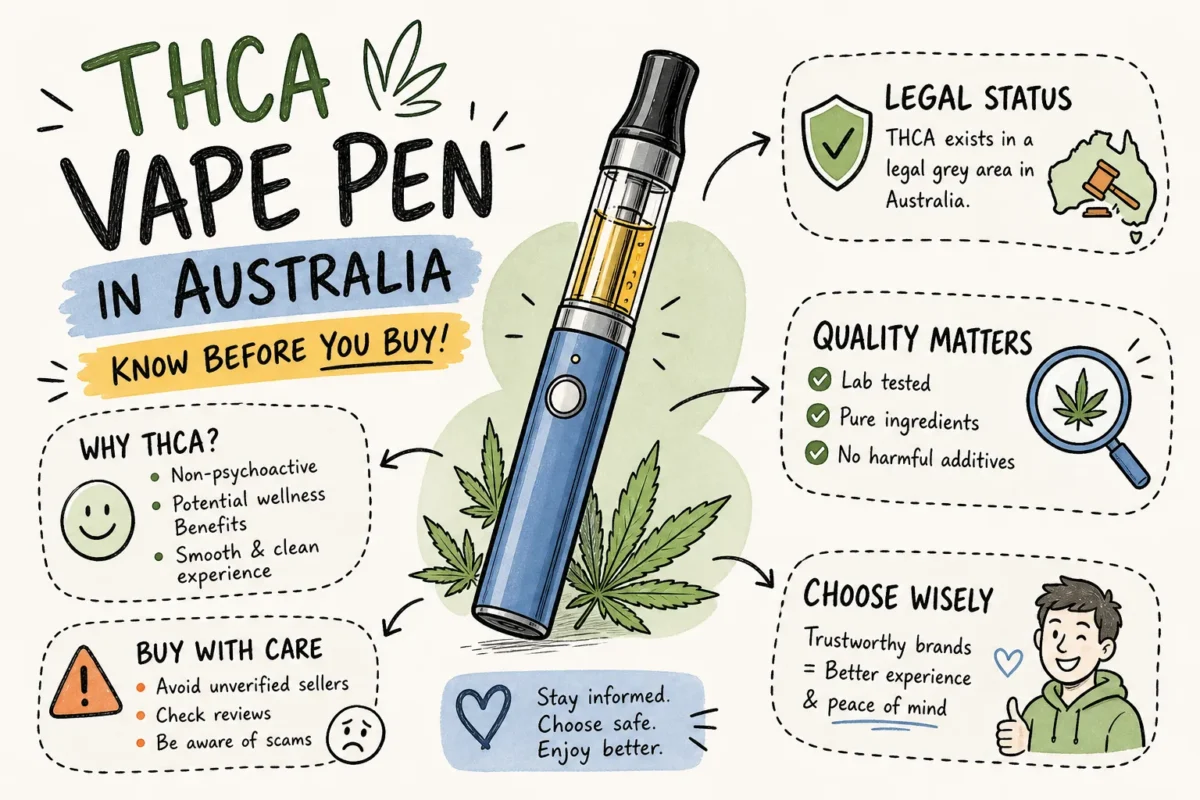
THCA Vape Pen Australia: What You Must Know Before Buying
26
Jun
Jun
If you’re researching a THCA vape pen in Australia, the first thing worth knowing is that most of what you’ll read online is written for a US audience operating under entirely different laws. THCA vape pens have attracted growing interest from Australian buyers, yet most people searching for them don’t fully understand what they’re purchasing, what Australian law actually says, or what’s sitting inside that cartridge. That’s a problem worth fixing before you hand over your money.
A lot of the noise around THCA is driven by the US market, where hemp-derived THCA occupied a legal grey area under federal law. Australia is a different story entirely, and the rules here don’t follow the American playbook. The information you find on US-focused sites can lead you seriously astray when you’re trying to make sense of THCA vape pens in Australia.
This guide covers the pharmacology in plain terms, the legal position stated clearly, the safety checks that actually matter, and what separates a trustworthy seller from a risky one. Read through first, then decide.
What a THCA vape pen actually is
THCA stands for tetrahydrocannabinolic acid. It’s the raw, acidic precursor to THC found naturally in the cannabis plant before heat is applied. In its unprocessed form, THCA is non-psychoactive. This is the starting point most buyers get wrong, and it shapes every marketing claim you’ll encounter about these products.
A THCA vape pen is a device that heats a THCA distillate or concentrate to the point of vaporisation. The hardware is identical to a standard THC disposable pen or cartridge: a battery, a heating coil, and a chamber loaded with cannabinoid extract. The product itself comes in two main forms. THCA distillate pens contain a processed, purified concentrate. THCA cartridges are either pre-filled or refillable, with the cannabinoid content and purity varying depending on the extraction method used.
Products sold in Australia’s grey market typically include THCA disposable pens sourced from overseas manufacturers, though the range varies considerably between sellers. The surface-level distinction between a THCA vape and a standard THC vape is that one contains the acid-form precursor while the other contains already-active Delta-9 THC. This distinction is why THCA attracted attention in the US as a potential legal workaround. In practice, that distinction collapses the moment you press the button. (See THCA Vape Pen Australia | Shop Quality THC-A Vape in Australia for how vendors categorise these products in online listings.)
The chemistry that changes everything when you vape THCA
This is the section most buyers miss, and it’s the most important thing to understand before you use one of these products. When heat is applied to THCA, a process called decarboxylation occurs. The acid group breaks off the molecule, which then converts to Delta-9 THC. At standard vaping temperatures of around 175°C and above, this conversion is near-instantaneous and reaches 95, 100% efficiency. Vaping THCA is pharmacologically identical to vaping THC.
The practical outcome is full CB1 receptor activation and full psychoactive effects, with the same onset and duration you’d expect from inhaled Delta-9 THC: roughly 2, 4 hours. Any marketing claim positioning a THCA distillate pen as a “mellow” or “legal-adjacent” alternative to THC is not supported by the pharmacology. For comparison, Delta-8 delivers approximately 50, 75% of Delta-9’s potency. Vaped THCA is not in that category; it delivers full-strength effects.
Some products are labelled as THCA cartridges to imply they’re distinct from THC vapes. Once used as intended, that distinction does not exist. Buyers should make decisions with this understanding front and centre, not as an afterthought discovered mid-session.
Legal status of THCA vape pens in Australia: what the law actually says
THCA is not legal to buy, possess, or import for personal use in Australia. No hedging, no qualifications. THCA is not explicitly listed as a separate compound in the Poisons Standard, but it is treated as structurally analogous to THC and covered under analogue drug laws. The Therapeutic Goods Administration (TGA) framework applies a Schedule 9 (Prohibited Substance) classification to THC; THCA falls under the same regulatory umbrella. Australia has no hemp-derived THC exemption comparable to the US Farm Bill approach. For an overview of the TGA’s recent approach to vaping products and regulatory changes, see the relevant TGA guidance on changes to vape regulation.
State and territory drug laws adopt the Poisons Standard classifications into criminal offences. Possession or supply of any prohibited drug, including THCA treated as a THC analogue, carries criminal penalties ranging from fines to imprisonment depending on quantity and jurisdiction. Western Australia sits at the severe end, with penalties of up to $21 million in fines and 15 years imprisonment for certain illegal vaping product offences. Other states carry maximums in the range of 10, 15 years and substantial financial penalties.
The ACT’s personal cannabis possession rules come up regularly in these conversations. Personal possession of small quantities of marijuana is permitted in the ACT, but this does not create a legal retail market, and it does not legalise THCA products imported from overseas or unlicensed sources. Buying a THCA vape pen online in the ACT is still illegal under the same framework that applies everywhere else.
The only lawful pathway to THC-containing products in Australia is through the TGA’s medicinal cannabis programme, which requires a prescription from a licensed doctor. THCA is not currently approved as a standalone therapeutic under that programme.
Safety: what’s actually inside that cartridge
Product safety is where buyers take on the most unacknowledged risk. The grey market for cannabinoid vape products has a documented contamination problem, and an unverified THCA vape pen is a genuine health risk, not just a legal one. There are four main categories of concern:
- Heavy metals, lead, cadmium, arsenic, and nickel, which can leach from low-quality heating coils
- Harmful cutting agents, most notably Vitamin E acetate, which produces toxic ketene gas when heated
- Residual solvents, butane, propane, and ethanol carried over from the extraction process
- Pesticides, chemical residues from the source plant material
Vitamin E acetate is particularly significant. It was the cutting agent linked to the EVALI lung injury outbreak and has been found predominantly in black-market products, according to public health investigations including CDC analyses. It’s visually indistinguishable from clean oil and has no flavour, so there’s no way to detect it without lab analysis. For background on common cutting agents and why they matter, review materials explaining understanding cutting agents in cannabis vape pens. This is why a Certificate of Analysis (COA) from a third-party laboratory is not optional if you’re taking product safety seriously.
Two primary analytical methods are used to verify vape products. ICP-MS (Inductively Coupled Plasma Mass Spectrometry) tests for heavy metals at trace levels. GC-MS (Gas Chromatography-Mass Spectrometry) identifies residual solvents, cutting agents, and degradation byproducts. A legitimate COA should include results for all four contaminant categories, not just cannabinoid potency.
When reviewing a COA, check for the following:
- An independent, verifiable lab name
- A batch number that matches the specific product you’re purchasing
- A recent test date
- Pass/fail results covering heavy metals, solvents, pesticides, and microbials
A COA showing potency only, with no safety panel, or carrying a lab name that can’t be independently verified, is a red flag that should stop the purchase. For practical guidance on how to interpret laboratory reports and Certificates of Analysis, see the official How to Read a COA guide.
Recent analytical work has also highlighted that metal particles can be present in vape hardware and aerosols even before first use, underlining the need for ICP-MS testing rather than assumptions about “new” devices. For a technical discussion of metal contamination in vaping products, consult research summaries such as those reporting on toxic metal particles in cannabis vapes.
What to look for in a reputable seller of THCA vape pens in Australia
In Australia’s grey market, the seller’s credibility is your primary quality control mechanism. There’s no regulatory body checking the shelves. Your due diligence replaces that oversight entirely.
A reputable seller publishes COAs: not a claim that products are lab-tested, but actual downloadable reports linked to specific products and batches, showing the lab name, batch number, test date, and results across all contaminant categories. They stock recognised brands with traceable origins rather than white-label generics. Their fulfilment is discreet and reliable, and the buying process reflects a professional online retailer rather than a back-channel transaction.
About | Buy THC Vape Online Australia operates in this space and is worth assessing against those criteria. When evaluating any seller, use the same standard: lab-verified stock, transparent brand sourcing, and dependable delivery that doesn’t leave you guessing about the product inside the package. If you’d like to see available product demos and how sellers present batch information, take a look at Explore | Buy THC Vape Online Australia.
Before buying from any seller, ask these questions directly:
- Can you provide the COA for this specific batch?
- What brand manufactured the oil, and what extraction method was used?
- Does the product contain Vitamin E acetate or any other cutting agents?
A seller who deflects or can’t answer these questions clearly is a seller worth avoiding.
What to know before you take that first hit
Drug testing is the issue that catches people most off guard. Many buyers assume THCA vape products are somehow cleaner on a standard drug test. They are not. Vaped THCA converts to Delta-9 THC, which metabolises into THC-COOH, the exact compound that standard immunoassay urine tests detect. Detection windows are consistent with regular cannabis use: approximately 3 days for a single session, 5, 7 days for moderate use, around 10, 15 days for daily users, and up to 30, 60 days for chronic heavy use. If you’re subject to workplace drug testing, a THCA vape pen offers no advantage over standard THC products. For practical detection window estimates, see resources on how long weed stays detectable in urine.
For new users, the dosing approach should reflect what this product actually is: a full-potency Delta-9 THC delivery device. As general harm-reduction guidance, start with one or two short inhalations, wait 15, 20 minutes before assessing how you feel, and avoid high-frequency use until you understand your own response. Commercial THCA vape products are typically high-potency; there’s no gentle entry point built into the product, so you need to create one yourself through measured use.
Storage also matters. Keep the device upright and away from heat and direct sunlight. Avoid over-tightening cartridge connections. Check for changes in colour or consistency that might indicate degradation. A product that’s been exposed to high heat during shipping may have already begun to break down before you’ve opened the package, which affects both the quality and the safety of what you’re inhaling.
The bottom line on buying a THCA vape pen in Australia
The pharmacology is real: vaped THCA is Delta-9 THC in effect, full stop. The legal position is clear: buying, possessing, or importing a THCA vape pen in Australia sits outside what the law permits without a prescription. The safety risks are manageable, but only if you source from sellers who publish verified, batch-specific lab reports and can account for every ingredient in the product.
The gap between a safe purchase and a risky one comes down to who you buy from and what verification they provide. Prioritise lab-tested THCA vape pens from sellers who can demonstrate their stock is verified, where you can confirm what’s inside the cartridge before it reaches you, not after. That’s the standard worth holding every seller to, and it matters considerably more than the brand name printed on the packaging.

Pingback: Can You Get THC Delivered to Your Door in Australia?