

No products in the cart.
THC Vape Online Australia
THCP vs Delta 9 Gummies: Which Is Stronger in Australia?
03
Jul
Jul
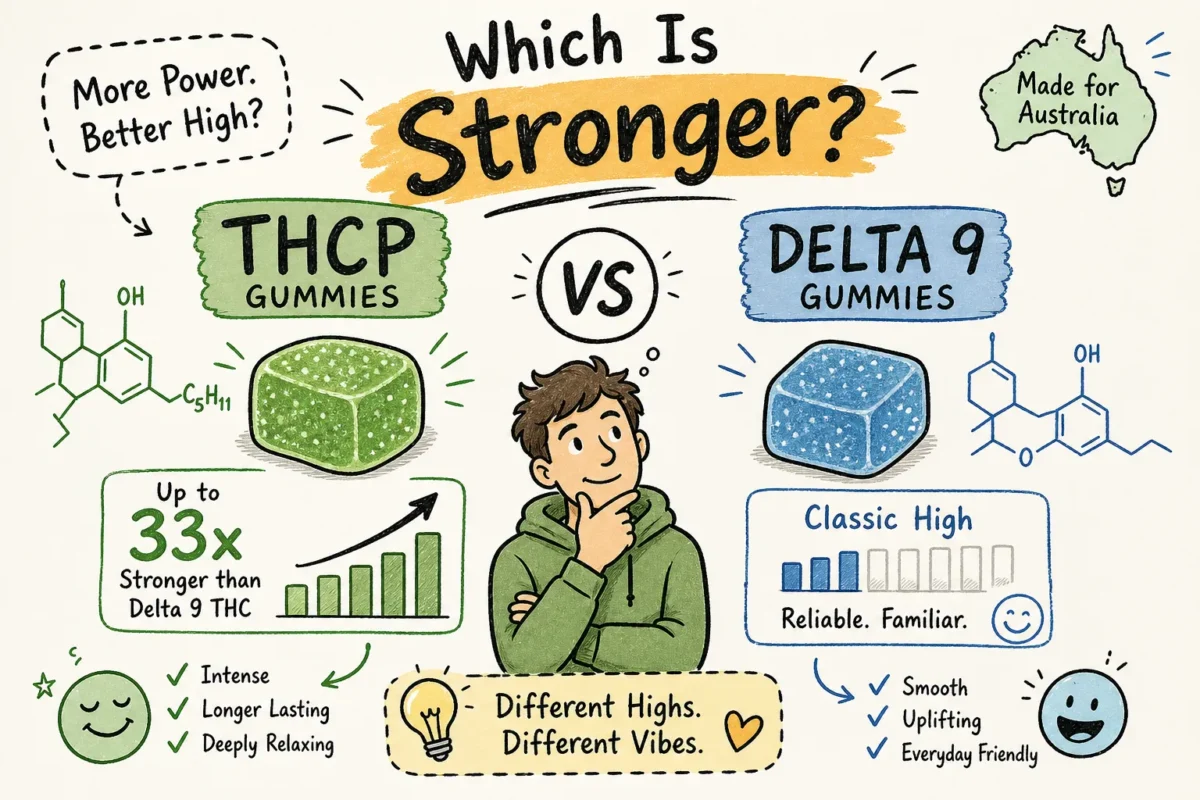
So, are THCP gummies stronger than Delta 9 gummies in Australia? The short answer is yes, but not in the way most marketing suggests. The “33x stronger” claim gets thrown around constantly in THCP promotions, and it stops people in their tracks. If that number is real, does that mean you take 33x less? No. The long answer is what actually matters, and it’s where most buyers go wrong.
The 33x figure comes from a legitimate peer-reviewed study on receptor binding. But receptor binding is a lab measurement, not a reliable guide for how a gummy is going to hit you on a Tuesday night. The practical potency gap between THCP and Delta 9 is real and significant, just not what the marketing implies. Understanding the difference is what separates a good experience from a bad one.
THC Vape Online Australia stocks both THCP and Delta 9 gummy options, so the comparison is practical, not hypothetical. But choosing the right product starts here, before you add anything to your cart. By the end of this article you’ll know how these two cannabinoids compare on potency, what that means for dosing, what to expect from each experience, and where both sit legally in Australia.
Are THCP gummies stronger than Delta 9 gummies in Australia? The CB1 receptor explanation
The binding affinity gap between THCP and Delta 9
The foundational research on tetrahydrocannabiphorol, commonly abbreviated THCP, comes from Citti et al. (2019), published in Scientific Reports. That study measured how tightly THCP binds to CB1 receptors compared with Delta 9 THC. The results were striking: THCP showed a binding affinity of 1.2 nM, compared with Delta 9’s roughly 40 nM. That 33-fold difference in tetrahydrocannabiphorol potency at the receptor level is where the “33x stronger” claim originates. The original Scientific Reports paper presents the receptor binding data that underpins this claim.
To understand what that means, think of the CB1 receptor as a lock and cannabinoids as keys. Delta 9 fits reasonably well. THCP fits much more tightly, thanks to its longer heptyl side chain, which allows it to insert more deeply into the binding pocket. The researchers noted that THCP’s CB1 affinity was comparable to CP55940, one of the most potent synthetic cannabinoids used in lab research. That is not a comparison to take lightly.
Why 33x binding doesn’t mean 33x stronger in practice
Receptor binding affinity is measured in vitro, in a dish, not in a human body. The way a cannabinoid behaves once it enters your system involves metabolism, receptor saturation, individual tolerance, and a dozen other variables that a binding assay does not capture. Based on anecdotal reports and expert interpretation of the limited data available, the practical psychoactive difference between THCP and Delta 9 gummies in Australia is estimated to sit closer to 5 to 10 times, not 33 times. This estimate is tentative; it is not derived from controlled human trials, and individual responses will vary considerably.
That distinction matters. Five to ten times stronger than Delta 9 is still an enormous gap. A dose that would feel mild with Delta 9 can become overwhelming with THCP. The 33x figure is not wrong; it just doesn’t translate directly to human experience in the way the marketing implies.
What the potency gap means for your gummy dose
Milligrams matter more than the marketing claim
A 10 mg Delta 9 gummy is a moderate dose for a regular cannabis user. At 5 to 10 times estimated real-world potency, a THCP gummy in the 1 to 3 mg range may be roughly comparable in effect, though this equivalency is approximate, given the absence of clinical dosing data and the significant variability between individuals. That is a very small amount of product to manage carefully, and most THCP gummies are not dosed that low unless the brand has specifically designed for cautious consumers.
Edibles add another layer to this. When you eat a THC product, your liver converts Delta 9 into 11-hydroxy-THC before it reaches your brain. That metabolite crosses the blood-brain barrier more efficiently than Delta 9 itself, which is why edibles feel stronger and last longer than inhaled cannabis at the same milligram amount. Whether THCP undergoes the same degree of metabolic amplification via a similar pathway is not yet established in human studies, the Citti et al. research focused on receptor binding, not oral pharmacokinetics. What is clear is that oral administration of any potent cannabinoid warrants extra caution, and THCP edibles demand more caution than any other delivery method. There is no established human dosing protocol for THCP, so you are working without a safety net. For a review of cannabinoid pharmacology and metabolism, see the relevant literature summarised in this open-access review.
The only safe starting point with THCP gummies
Start with the lowest available dose and wait the full two to three hours before considering more. That is not optional advice. With THCP edibles, the onset window is the same as any other edible, 30 to 90 minutes, but the intensity that arrives at the peak can be significantly harder to manage than Delta 9. Redosing before the first dose has peaked is one of the most common reasons people have a bad night.
For comparison, Delta 9 gummies have a reasonably well-understood beginner range of 2.5 to 5 mg. That baseline exists because thousands of clinical and consumer experiences have built it over time. THCP has none of that established data behind it. Patience is not a suggestion here, it is the only sensible approach.
What the experience actually looks and feels like
Delta 9 gummies: the known baseline
Delta 9 gummies are the reference point against which everything else gets measured. Effects onset within 30 to 90 minutes, peak around two to four hours in, and taper off within six to eight hours for most users. At moderate doses, the experience involves relaxation, euphoria, increased appetite, and a mild shift in perception. At higher doses, anxiety and paranoia become more likely, and sedation increases.
This predictability is genuinely valuable. You know roughly what you’re getting, how long it takes, and how long it lasts. For someone new to edibles or returning after a significant break, that consistency makes Delta 9 the responsible starting point.
THCP gummies: heavier, longer, less predictable
THCP experiences are commonly reported in anecdotal accounts as considerably more sedating and physically intense than Delta 9 at equivalent milligram amounts, though it bears repeating that controlled human data are lacking. Reports from THCP users describe effects that last well beyond the typical Delta 9 window, with some noting residual sedation extending into the following morning after an evening dose. A 2025 case report documented psychosis and severe psychological distress following a single use of THCP in an experienced cannabis user, which is the kind of outcome that deserves serious attention.
Anecdotal adverse reactions include severe anxiety, rapid heart rate, and disorientation. One reported extreme case involved a heart rate exceeding 200 bpm with a multi-day recovery period, this represents an isolated anecdotal extreme rather than a typical outcome, but it illustrates the upper end of the risk profile. THCP gummies are not appropriate for beginners, for anyone with a low tolerance, or for anyone who hasn’t built a solid and consistent Delta 9 baseline first. That is not a disclaimer for legal cover; it is a straightforward assessment of the risk involved.
How to check lab results before buying any gummy
What a legitimate certificate of analysis shows
A certificate of analysis (COA) from a legitimate, ISO/IEC 17025 accredited third-party lab will list the exact THCP or Delta 9 content per gummy alongside a full cannabinoid profile. It will also include results for heavy metals, pesticides, residual solvents, and microbial contaminants. Each of those contaminant categories should show “Not Detected” or “Pass.” A single failure in any category is a reason to stop.
The batch number on the COA must match the batch number printed on your product packaging. If they do not match, the test results cannot be verified for what you are actually holding. A recent testing date matters too. COAs older than 12 months provide limited assurance about what is currently in the product.
Red flags that should make you walk away
Avoid any product without a scannable or clickable COA link that connects directly to the testing lab. A PDF with no lab name, no accreditation number, or no batch-specific data is not a COA; it is a formatted document that proves nothing. The lab should be verifiable independently, meaning you can search the lab name and confirm it exists and holds proper accreditation.
When browsing at THC Vape Online Australia, both THCP and Delta 9 gummy options are listed with product details that let you compare cannabinoid content before purchasing. Knowing what is actually in the product before it arrives is the baseline standard, not an extra step. For example, you can view specific product pages such as THCP Blend Gummies Australia | Potent, discreet, and delicious to confirm dosing and COA details before you buy.
The legal picture for THCP and Delta 9 gummies in Australia
Delta 9’s classification under Australian law
Delta 9 THC is a Schedule 9 controlled substance under the Narcotic Drugs Act 1967. Legal access requires a valid prescription through the TGA’s medicinal cannabis framework. No recreational exemption exists at the federal level. Any edible product containing Delta 9 that is sold outside that prescription framework sits in the grey market, regardless of which state you are in. See the TGA’s guidance on medicinal cannabis for current access pathways: TGA medicinal cannabis product information.
The ACT has decriminalised personal cannabis possession up to 50 grams, but that applies to cannabis plant material and does not create a legal pathway for purchasing Delta 9 edibles. Western Australia proposed possession decriminalisation measures in 2026, but THC edibles remain outside any proposed carve-out. Every other state and territory treats recreational use as a criminal offence.
Where THCP sits legally in Australia
THCP is not explicitly named in the Narcotic Drugs Act 1967 or in the Schedule of Controlled Drugs under the Poisons Standard as of 2026. However, this creates legal ambiguity rather than a clear green light. The position on analogue provisions varies: some legal summaries treat THCP as potentially controlled as a structural analogue in practice, while others note it is not explicitly listed under any specific provision. Buyers should consult up-to-date guidance from the Office of Drug Control or a legal adviser, as the precise treatment under federal and state law remains unresolved and jurisdictional differences apply. For state-level regulatory context, see Victoria’s overview of its medicinal cannabis regulatory framework: Medicinal cannabis regulatory framework (Victoria).
That ambiguity is not the same as permission. Authorities can still act under general drug laws if a product is deemed a new psychoactive substance with effects similar to a controlled compound. The enforcement approach is case-by-case. Anyone purchasing THCP gummies across all Australian states and territories should understand the legal exposure involved, “not explicitly listed” does not mean “no legal risk.”
Choosing the right gummy for your tolerance level
Matching the product to where you actually are
Delta 9 gummies are the right call for anyone new to THC edibles, returning after a significant break, or operating at a lower tolerance. The effects are well-characterised, the dosing range is forgiving enough to course-correct from, and the overall experience is far easier to navigate than THCP. If you have not had a solid, consistent Delta 9 experience with edibles, THCP is not the next step.
THCP gummies are for experienced users who have a thorough understanding of their Delta 9 response and want something more potent. That means knowing your ceiling with Delta 9, not just having tried it once or twice. The longer duration and higher sedation risk with THCP make honest self-assessment non-negotiable before you make that jump.
Browsing THCP vs Delta 9 gummies in Australia side by side
THC Vape Online Australia stocks both Delta 9 and THCP gummy products in one place, so you can compare cannabinoid content, product specs, and dosing information without hunting across multiple sources. Given the grey-market context discussed above, verify COA documentation for any product before purchasing. You can compare specific item listings such as THCP Blend Gummies Australia | Potent, discreet, and delicious directly on the site to check lab data and dosing.
Start with the lower-potency option. Give yourself enough time across multiple sessions to understand your response before making any decision about stepping up. That approach is not overcautious; it is the only way to build a reliable picture of where your tolerance actually sits.
The bottom line: are THCP gummies stronger than Delta 9 gummies in Australia?
Yes, meaningfully so. But the 33x binding figure is a lab measurement of tetrahydrocannabiphorol potency at the receptor level, not a dosing instruction. The estimated practical potency gap in humans sits closer to 5 to 10 times, based on anecdotal reports and limited data rather than controlled trials, and that difference still demands real respect, especially in an edible format where the pharmacology is not yet fully characterised for THCP.
Dosing low, reading lab results, and being honest about your tolerance are the non-negotiables here, regardless of which product you choose. Both options operate in a legally complex space in Australia, and that context is worth keeping front of mind. If you are still working out which product suits you, starting with a well-dosed Delta 9 gummy is the sensible move before considering anything stronger. When you are ready to compare THCP gummies against Delta 9 gummies in Australia and decide which suits your experience level, make sure the product you choose has a current, verifiable COA, that applies to both options, every time. For related reading on similar cannabinoid comparisons, see How Do HHC Gummies Compare to THC Gummies for Relaxation in Australia.
